On 28 March 1838, Charles Darwin stepped into London Zoo and locked eyes with Jenny, his very first orangutan, and later penned a striking reflection in his notebook: “Man in his arrogance thinks himself a great work, worthy the interposition of a deity. More humble and I believe true to consider him created from animals.”1,2 In other words: humans are arrogant enough to think that God must have made us so special! Darwin, however, believed it to be more accurate and humble to see that humans evolved from animals.
Four years later, Queen Victoria crossed paths with another orangutan at the same zoo, also called Jenny, and was left deeply rattled by a creature she stiffly dismissed as “frightful and painfully and disagreeably human”1, a classic royal crisis of identity!
Yet while nineteenth-century Londoners were having an existential meltdown over their new furry relatives, the people of Sumatra and Borneo had long known these tree-dwellers as the mawas and maias.3 Among the Dayak of Borneo, an old story holds that these apes are humanity’s older, wiser siblings.4 To some Iban in Sarawak they are closer still: the returning souls of their ancestors.5 And local folklore jokes that these apes actually know how to talk, but they choose to stay completely silent in the trees just to avoid being captured and forced to labour.4
Twelve Million Years of the Orangutan Line
During the ice ages, so much water was frozen into ice that the sea was up to 120 metres lower than it is today. Sumatra, Java and Borneo were joined to the mainland by a huge stretch of land called Sundaland, and orangutans could move between them on foot.8
When the ice melted, the seas rose and Sundaland slowly disappeared under the water. By about 12,000 years ago, orangutans had vanished from mainland Asia and Java. They survived only on Sumatra and Borneo, in roughly a fifth of their old range.9
Today, wild Sumatran orangutans live mainly in the Leuser Ecosystem, and Tapanuli orangutans only in Batang Toru. Rescued orangutans have been returned to two forests that had lost them, Jantho and Bukit Tigapuluh (marked *). Bornean orangutans survive in scattered patches of forest, mostly in Sabah, south-west Sarawak and Kalimantan.10,11
Hunters
But this ancient family wasn’t always a peaceful neighbourhood. Humans have been gatecrashing the highlands of western Sumatra for over 63,000 years, a milestone scientists confirmed after finding ancient human teeth in Lida Ajer cave in West Sumatra: our earliest official “receipt” for rainforest living.12
By the time humans settled into Niah Cave in Borneo, some 46,000 years ago, our ancestors had put their “older siblings” on the dinner menu, which was probably one reason orangutan numbers fell.9,13 It did not help that orangutans are spectacularly unhurried when it comes to family planning. They hold the record among mammals for the longest gap between births: a mother orangutan waits around 7.6 years between babies.14 She does not even have her first until she is about fifteen, and raises a grand total of just three or four in her entire life.15 In the brutal mathematics of survival, every adult taken by a hunter left a gap that took many years to fill.
A Complicated Kinship
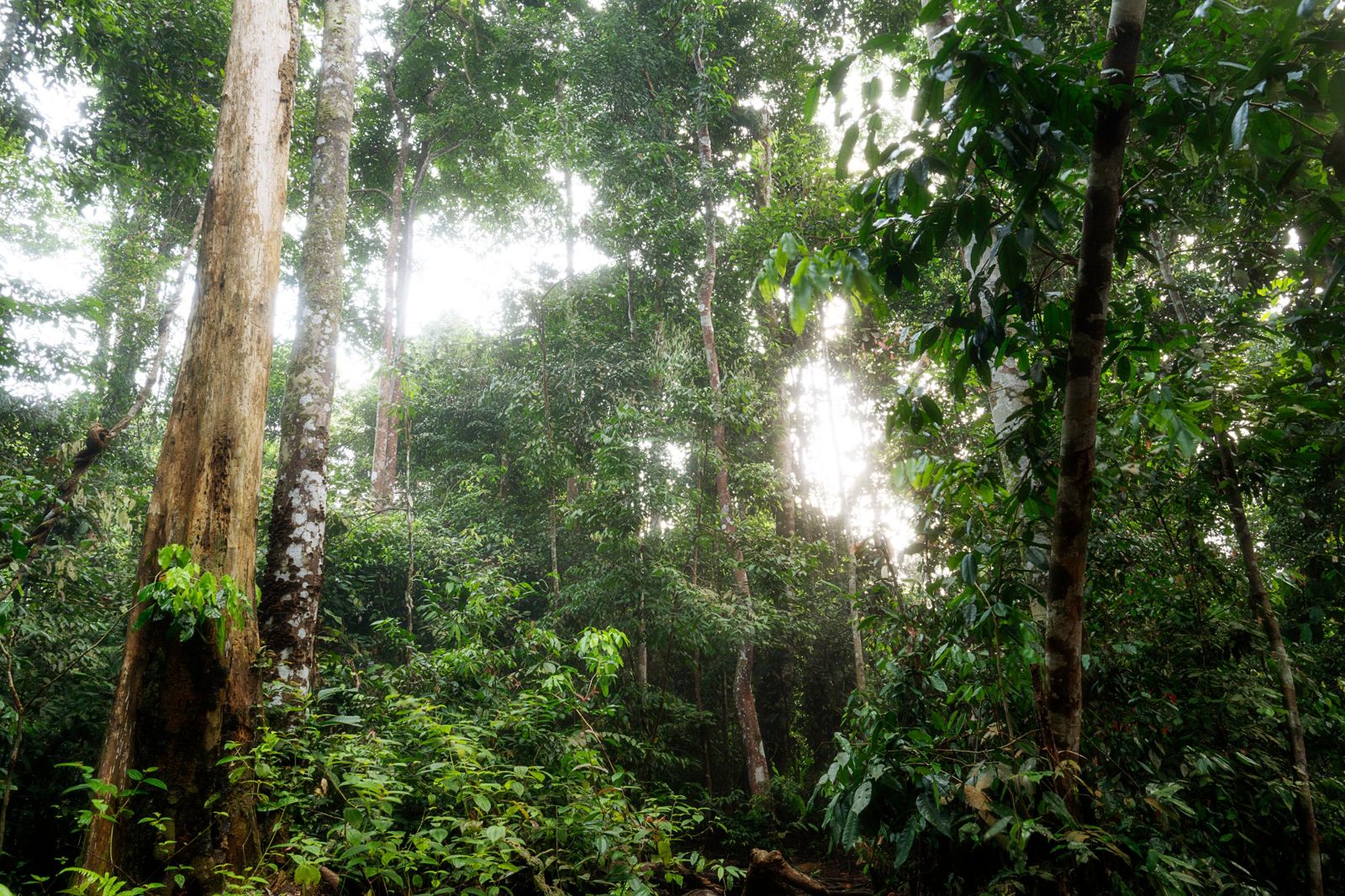
While “orang utan” cleanly translates to “person of the forest” in Malay, sharing a postcode with them across Sumatra and Borneo has always meant a complicated, and sometimes highly awkward, relationship. Depending on which valley you happened to stumble into, the local attitude towards your canopy neighbours varied wildly.
The Dining Table Dilemma. In some corners of Borneo, communities hunted them for meat and for ornaments. Yet just a valley over, others treated the apes with reverence and forbade harming them at all.16
High-Stakes Staring Contest. Travel into central Borneo and you quickly learned to keep your eyes to yourself. A local superstition warned that looking one in the face would bring you bad luck.16
They Are Like Us: What Science Found
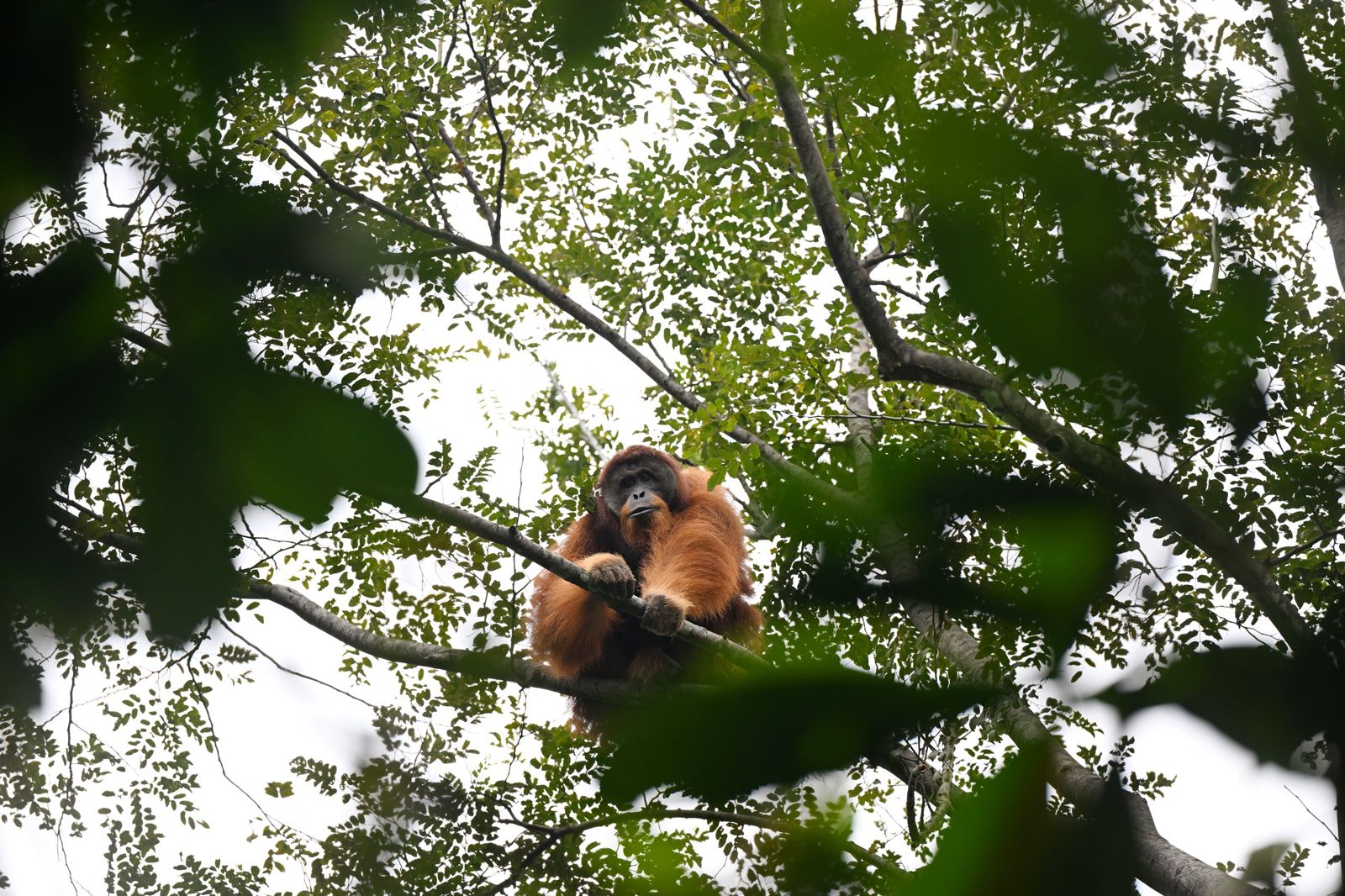
Over the last few decades, science has steadily confirmed what local folklore long implied: our forest cousins have an intelligence that mirrors our own.
- 1981The Mirror Test. Orangutans recognise themselves in a mirror, a rare sign of self-awareness.17
- 2003The Culture Club. A landmark study co-authored by Ian Singleton showed that orangutans have distinct cultures. Researchers identified 24 learned behaviours, from tool use to the sounds they make, passed down through the generations. Orangutans in one forest can have quite different customs from those in the next.18
- 2011The 3% Buffer. Genetic sequencing confirmed that humans and orangutans share 97% of their DNA, leaving a mere three per cent between us.19
- 2022Dr Rakus. In the Leuser Ecosystem, a wild male named Rakus made scientific history. After a bad wound to his face, he was seen chewing the leaves of akar kuning, a traditional medicinal vine, and pressing the juice onto the wound. It closed within five days: the first known case of a wild animal treating a wound with a medicinal plant.20
A Timeline of Hope: Orangutan Rescue in Sumatra and Borneo
As people pushed further into the forest, scientists, local heroes and international organisations rose to fight for the survival of the maias and mawas, and Sumatra and Borneo became the front line of orangutan rescue.
Ketambe Research Station. Deep in the Leuser forest of Aceh, a research station opens: the first long-term study of wild Sumatran orangutans, and the start of much of what is known about them today.21
1973Bukit Lawang. Swiss zoologist Regina Frey opens a rehabilitation centre on the edge of the Leuser forest, returning ex-pets and orphans to their rightful home in the canopy.22
1999SOCP. Ian Singleton, with PanEco and YEL, sets up the Sumatran Orangutan Conservation Programme (SOCP), opening a quarantine centre near Medan to treat and train confiscated pets.23
2001OIC. Panut Hadisiswoyo founds the Orangutan Information Centre (OIC) to work with the communities along the forest edge.24
2003–11Reclaiming lost ground. SOCP establishes new wild populations in two places where orangutans had vanished: Bukit Tigapuluh in Jambi (2003) and Jantho in Aceh (2011).25
2023Orangutan Haven. For those whose scars run too deep for release, the Orangutan Haven opens its island sanctuaries near Medan. Its first residents include orangutans left blind after being shot with air rifles, and one survivor who spent 19 agonising years in a cage about a metre and a half wide.
Sepilok. Sepilok opens in Sabah, the first official centre for rescuing orphaned orangutans and returning them to the forest.26
1971Camp Leakey. Sent by the anthropologist Louis Leakey, Biruté Galdikas sets up Camp Leakey in Tanjung Puting, Central Kalimantan, to study wild orangutans, and begins caring for orphans there. With Jane Goodall (chimpanzees) and Dian Fossey (gorillas), she became one of Leakey’s “Trimates”.27
1975Semenggoh Wildlife Centre. Near Kuching, Sarawak, Semenggoh opens to care for orphaned and injured wildlife, orangutans among them. Its rehabilitation work later moved to Matang.28
1986OFI. Galdikas founds Orangutan Foundation International (OFI), later running a care centre at Pasir Panjang, where orphans are raised before release.29
1991–2006BOS. Borneo Orangutan Survival (BOS) begins at Wanariset, East Kalimantan, rescuing orangutans from cleared forest and the pet trade. Nyaru Menteng follows in 1999 and Samboja Lestari in 2006.30
Learning to Be Wild
From the 1960s, as the forests were cleared and broken up, more and more orangutans needed rescuing, and dedicated rescue centres opened to take them in. Some are confiscated from the illegal pet trade. Others are found injured, or stranded far from the forest they need.31 For the orphaned young ones, everything starts with mothering. In the wild, a young orangutan stays by its mother’s side for nearly a decade to learn how to survive. Without her, human carers have to do the mothering instead.
01Clinic and Recovery
Not every new arrival is a blank slate. Many are confiscated pets, or adults found injured on farmland, like one male rescued with seven air-rifle pellets in his body.32 Every newcomer starts in quarantine for an intensive health check and parasite scrub, before carers step in with round-the-clock warmth to nurse them back to health.33
02Forest School
In the wild, a baby clings to its mother for nearly a decade, nursing until at least age eight.34 Without her, these orphans have to learn how to be apes from humans. Carers lead them into the canopy to learn essential survival skills: how to climb safely, how to forage, and how to weave a fresh nest high in the branches every single night. They also have to unlearn bad pet habits, like walking on the ground or begging humans for food.
03Graduation
The ultimate goal is a triumphant return to a protected wild forest. There are no graduation caps, mostly because the students would just eat the tassels, but there is a final term at a forest-edge release station before the doors open. Even then, monitoring teams track the graduates from dawn until they build their night nests, obsessively noting every single berry they eat.35
04A New Generation
Releasing rescued apes into an existing population is already a challenge. Starting a brand-new generation from scratch is a far bigger gamble. In 2001, a high-stakes plan was launched by SOCP and Ian Singleton to release rehabilitated orangutans into forests where they had completely died out.36
Against all odds, the gamble paid off twice. Over 395 furry pioneers have been released back into the canopy at Jantho in Aceh and Bukit Tigapuluh in Jambi. Today, trackers have counted 37 confirmed babies born completely free in the wild.37
While their mothers had to graduate from human-led forest school first, these infants are an entirely new generation who have never known human contact, living completely wild. Today, these are the only two places on Earth where Sumatran orangutans have been brought back to forests that had lost them.38
05Heaven in Haven
A few can never go back, because they are blind, badly injured or too dependent on people. For them, sanctuaries such as the Orangutan Haven give a permanent, peaceful home, where they can live out their lives in safety and dignity.
The Cost of Survival: A Crisis in Numbers
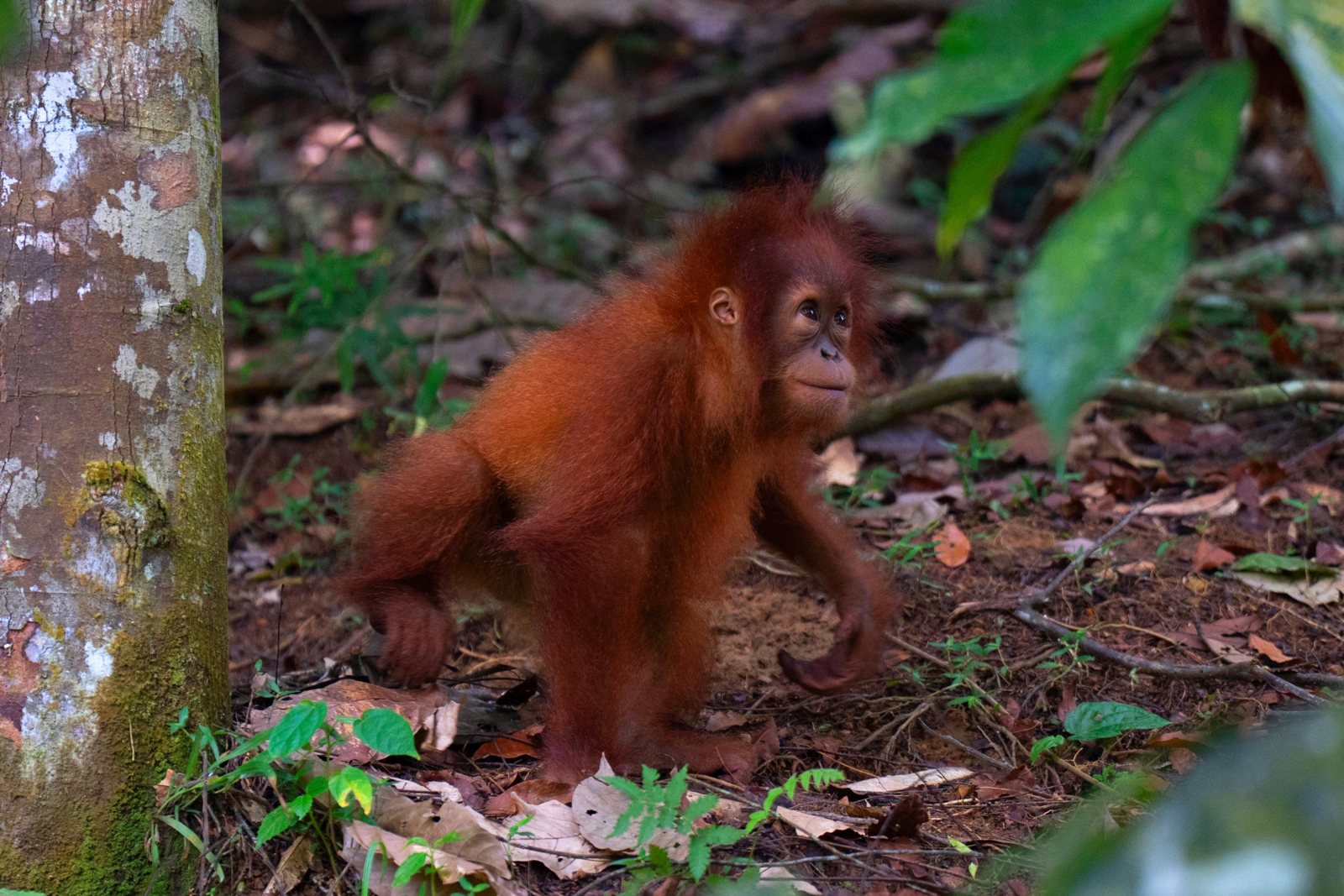
The latest surveys, published in June 2026, confirm a devastating reality: all three species of orangutan are Critically Endangered, and the battle for the canopy is moving faster than ever.10
The population has dropped by about 19.5% since 2016. A staggering 94% of the survivors rely on a single stronghold: the Leuser Ecosystem. In the Tripa peat swamps, numbers are estimated to have collapsed by 75%, from about 212 to just 52 (a modelled estimate).39
The rarest great ape on Earth. The species suffered a catastrophic blow in November 2025, when landslides triggered by Cyclone Senyar killed an estimated 58, roughly 7% of the entire species in a single event.40 The survivors are split into three groups, growing more cut off from one another.41
About 148,500 have been lost since 1999.43 Most vanished from places where the forest still stood, which points to killing. A further 45,000 are projected to be lost by 2050.
Two Lives, One Clock: Hillary and the Shrinking Forest
Hillary, the young pianist who will be featured in Hands Like Ours, was born in 2011. An orangutan born that same year would be fifteen today, the age at which a wild female typically gives birth to her very first baby.15 But while they grew up, Sumatra’s orangutans grew fewer: about a fifth fewer since 2016.10
See how they grow up, year by year, as rescued orangutans return to the forest, in the slider below.
True to the ancient stories, the forest elders have stayed quiet.
Would things have turned out differently if orangutans could speak?